





AI training · corporate · public sector · manufacturing
AI training built for the work
Assess · design · practice · adopt
Not a generic lecture. Every course is designed around real tasks in your industry and role, runs 70% hands-on, and we stay with you from rollout to adoption.
- 18,000+ trained · 300+ organizations
- 535 instructors · three-stage vetting
- Public-sector security and lab requirements covered
Organizations trained by Imagination Group





What does the AI training program cover, and how?
Imagination Group's AI training program is hands-on coursework that gets employees in companies, public institutions, and factories using generative AI such as ChatGPT, Claude, and Gemini in their own work. We start with an assessment of where the organization stands, then design the path from AI literacy for everyone to role-based courses and advanced work on AI agents and automation. Seventy percent of the time is practice, and we stay on after the course until the new habits stick.


AI training usually
starts with one of these
01
We don't know where to start
There is no easy way to measure where our organization stands on AI
02
People learn it but don't use it at work
A gap sits between the course and the actual job
03
Every role needs something different
The same course for everyone does not work
04
What happens after the course matters more
The new skill has to survive contact with real work
We connect training results to real organizational change
See the impact
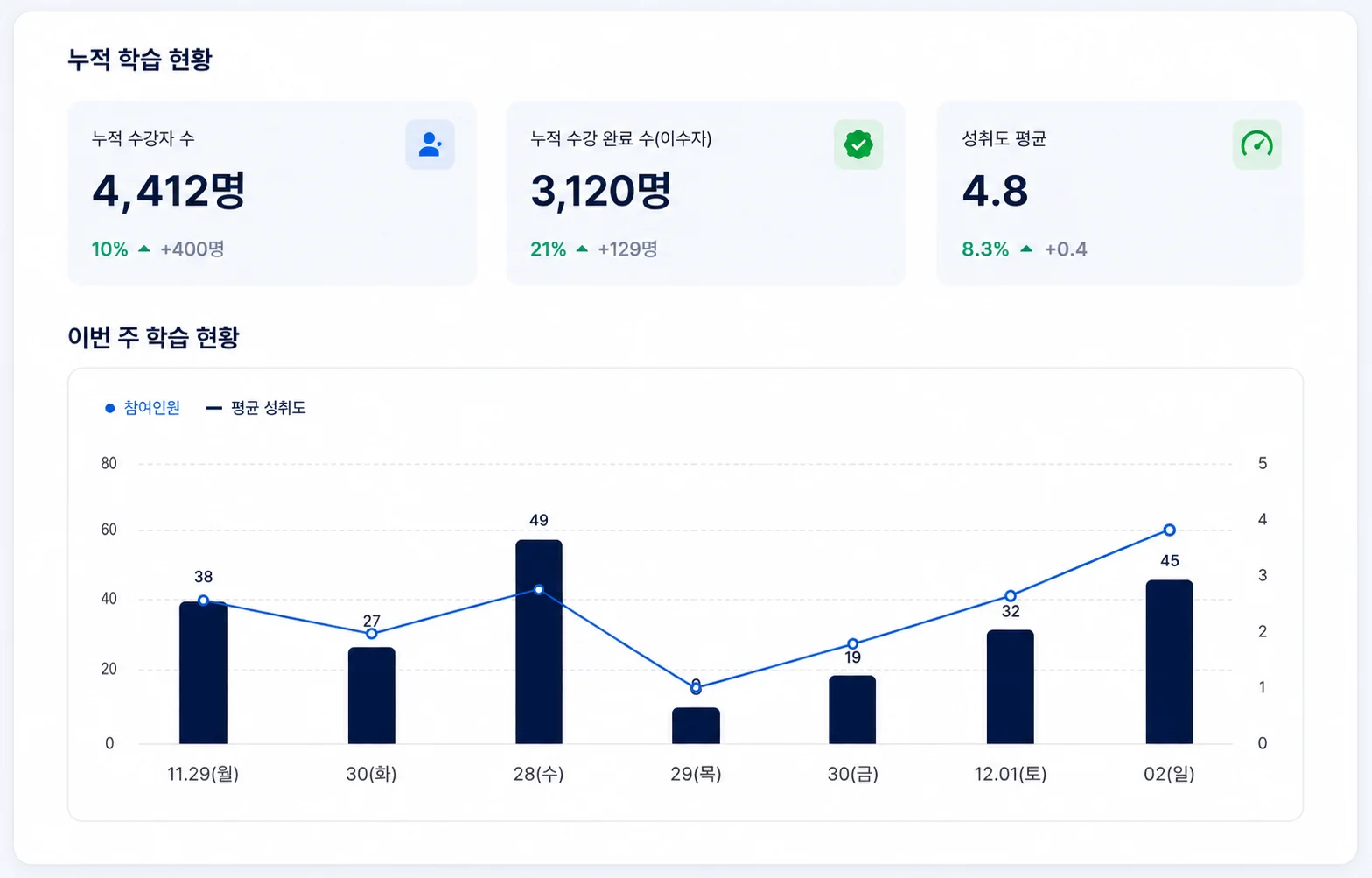
in numbers
Assessment and course data show how your people's AI capability moves



Design the training
your organization needs
Courses are assembled around each role's current level of AI use



Follow the change
after the course
We stay past the last session, through real usage and the results that follow
Pick the program for your people
Each course is built in the language and the data of its setting — corporate, public sector, or the factory floor.

For Company
Corporate AI training
Hands-on training that changes how employees work. Role-based scenarios from ChatGPT through AI agents and advanced LLM use.
Learn more
For Public
Public sector AI training
AI training for civil servants and public institutions. Official document automation, AI literacy, and on-site expert placement — with security handled from the start.
Learn more
For Manufacturing
Manufacturing AI training
Training that solves problems with shop-floor data. Smart factory basics through predictive maintenance, vision inspection, process optimization, and physical AI.
- Smart factory basics
- Predictive maintenance
- Vision inspection and defect detection
- Process optimization
A course map built on capability level and role
We don't run the same course for everyone. Courses are placed by four capability levels and by role and industry.
Level 4
Strategy and governance
Executives and planning
- Executive AI strategy workshop
- AI ethics and governance guidelines
- Company-wide AI rollout program (40h)
- Framework Act on AI
Level 3
Advanced and production
Specialist roles
- Advanced LLM use
- AI for cost reduction
- AI creative workshop
- Image and video generation, in depth
- Public data analysis with AI
- Custom VOD production
- Live AI expert coaching
- AI for citizen service desks
- Physical AI
- Process optimization
Level 2
Applied to the job
Individual contributors
- ChatGPT mastery
- Workflow automation with AI
- Excel VBA with AI
- Slides with AI (Canva and Gamma)
- Excel data analysis with ChatGPT
- Competitor analysis with AI
- AI leadership for middle managers
- Official document automation
- Predictive maintenance
- Vision inspection and defect detection
Level 1
AI literacy
Everyone
- ChatGPT for beginners
- AI crash course
- One-day AI class for companies
- AI literacy for practitioners
- Smart factory fundamentals
Course length designed around the role
From grasping the concepts to hands-on work and restructuring the organization's data, hours are set by the nature of the work.
- Lecture
2 hours
Everyone
AI fundamentals and literacy
- Discussion
4 hours
Executives
Executive AI strategy workshop
- Hands-on
8 hours
Front-line service
ChatGPT prompting for beginners
- Hands-on
16 hours
Planning and policy
ChatGPT mastery and advanced LLM use
- Hands-on
16 hours

Admin and general affairs
Workflow automation with AI and Excel
- Production
24 hours
Marketing and comms
Image and video generation with AI
- Project
40 hours
IT and information security
Company-wide AI program with security practice
- Build
40 hours

Organization-wide data
Restructuring the organization's data
Hours are set by how much of the course is hands-on and organization-wide work, not by difficulty.
What formats does the training come in?
Six formats, chosen to fit your schedule and goal. Hours scale from a two-hour talk to a forty-hour company-wide program, and in-person sessions can be combined with live online training.
- 01
AI talks and seminars
Two to four hours for all staff or executives. An introduction to where generative AI is going and how your industry is using it.
Learn more → - 02
In-person hands-on training
Eight to sixteen hours. Participants bring their own work documents and finish role-based tasks end to end.
Learn more → - 03
Online AI training
Live online coaching and custom video courses for teams that cannot gather in one room, such as branch offices and shift workers.
Learn more → - 04
AI bootcamp
A short, intensive program that brings new hires and key staff up to speed, ending with a team project and presentation.
Learn more → - 05
AI hackathons and competitions
In-house or institution-wide contests where people apply what they learned to real problems. We run them from planning through judging.
Learn more → - 06
Instructor placement
When your own program needs an AI or ChatGPT instructor, we place one who has passed our three-filter check.
Learn more →
We are based in Seoul and have delivered training for institutions outside it, including Daejeon and Jeju. Ask us about on-site delivery in other regions such as Busan, Daegu, Ulsan, and Gwangju.

Learning happens at the desk, not in a lecture hall
30% theory, 70% hands-on. Participants bring their own work documents and leave with finished output.
- 70%Hands-on share
- 18,000+People trained
- 300+Client organizations
Four steps are enough to get AI in
One team owns it, from the first conversation through delivery and adoption.
01
Assess
We measure your AI capability
and set the target together.02
Design
We build the course around
the work your teams actually do.03
Train
Hands-on sessions turn
the tools into working habits.04
Apply
A 30-day adoption program
carries it into the day job.
Practice-first AI training, shaped by 18,000 participants
Curricula are designed around the industry and the roles of 230 organizations.
Generative image AI
Role-based skills
AI leadership for managers
Strategy
Custom VOD production
Company-wide rollout
AI for slides (Canva · Gamma)
Role-based skills
Live expert coaching
Company-wide rollout
Generative AI video
Role-based skills
Korea's AI Framework Act
Public sector
Factory optimization
Manufacturing AI

535 AI instructors, assigned after a three-filter check
Teaching history isn't enough. Only people who clear all three — real implementation, public sector teaching, and one-to-one coaching — get assigned.
- AI instructors in our own network
- 535
- External part-time instructors under standing contract
- 43
- Instructors deployed to date
- 134
- Courses in the catalogue
- 30+
The three filters
01
Real implementation experience
We check for automation that actually runs, not a teaching record. Only people who designed the workflow and connected the tools themselves get through.
02
Public sector and corporate teaching
We check for experience running training for public sector staff — cohort delivery, security compliance, and reporting.
03
One-to-one feedback and setup
We check whether they can give per-learner feedback on assignments and support installs and account setup, and whether they have run Q&A sessions alone through a multi-session course.
Each criterion is judged against a CV, delivery record, and work samples, and assignments are confirmed with the client before the course starts.
What public sector training has to satisfy
The practice has to be hands-on, but the institution's information has to stay safe. We prepare the security rules and the practice accounts together.
Using AI safely
Internal documents, personal data, de-identification, and institutional AI security
What comes up
- No standard for deciding whether internal material can go into an AI
- No procedure for de-identifying personal or sensitive data
- Concern about input data being used for training or sent overseas
- The institution's security policy isn't connected to any rules on AI use
How we handle it
- 1
AI ethics and risk guidelines
We review privacy, copyright, and bias risk, then write usage rules for your institution
- 2
Hands-on Enterprise security setup
We walk through the OpenAI and Claude Enterprise security settings with your lead
- 3
Input masking and auditing
AI Switch DLP masking, conversation audits, and IP allowlisting
- 4
AI security management dashboard
Patent pending for AI security management in the public and corporate sector (10-2026-0033627)
A practice environment that works
Paid AI accounts, short-term licenses, and accounts and software set up in advance

What comes up
- The free tier limits how far the practice can go
- Accounts are only needed for the course, but approval runs on annual, overseas payments
- Practising on personal accounts leaves institutional material in them
- Creating accounts and installing software eats into the first session
How we handle it
- 1
Paid accounts for the course
ChatGPT, Claude, Perplexity and 25+ others, at a fixed price in KRW
- 2
Short-term licenses
Subscribed only for as long as the course runs, with a per-account delivery note (PDF)
- 3
Separate accounts for the course
Issued separately so institutional material never lands in a personal account
- 4
Accounts and software set up in advance
Accounts created and software installed before day one, so practice starts in the first hour
Three layers of backup for the practice room
So a failure doesn't stop the class, we put a fallback in place for each point of failure before the course opens.
01
Hardware
PC failure or not enough seats
- We own the practice laptops — brought in the moment a lab PC fails or seats run short
- A second set of hardware set up alongside the room, sized against the seat count before day one
02
Accounts and software
Sign-in errors or a missed install
- AI tools installed and configured in advance — paid team accounts issued in bulk before the course (25+ tools)
- A bulk sign-in check the day before each session, with spare accounts ready to reissue on the spot
03
Network
Outage or slow connection
- Wired and wireless backup across all three carriers, plus mobile satellite internet, switched over the moment a line drops
- A connectivity check before the course opens, confirming ChatGPT, Claude, and Gemini aren't blocked


Hardware, accounts, and network requirements are confirmed against a checklist with the institution before the course is finalized.
After the training, the work itself changed
“ The sessions were built on our own roles, so people applied it the day after. Staff started treating AI as a working partner rather than a search box. ”
“ We practiced on our real drafting and citizen-response scenarios, so the team carried it straight into the job. Settling our security rules up front helped too. ”
“ Working with our own shop-floor data kept the equipment team engaged to the end. Solving an actual process problem together during the 30-day adoption window is what made it stick. ”
AI training FAQ
It runs in four stages: assess, design, practice, adopt. We assess how the organization uses AI today, design courses around its industry and roles, teach with seventy percent hands-on practice, and support adoption afterward. Courses span four levels, from AI literacy to role-based use, and on to AI agents and advanced LLM work.
Yes. We run live online coaching with AI specialists and produce custom video courses, so a program can be blended with in-person sessions or delivered fully online. We recommend in-person for practice-heavy courses and a blended format for organizations with many branches or shift work.
It depends on headcount, hours, format (talk, in-person practice, online, bootcamp), and whether we supply practice accounts. We do not quote from a fixed price list. After a free AI assessment and a consultation we propose a program and an estimate together.
Yes. Our public-sector courses cover official document automation, civil complaint handling, AI literacy, and executive briefings, and they run within public-sector security and lab requirements. We also handle cohort-based operation and result reporting.
Yes. We run separate courses on the AI Basic Act and on AI ethics guidelines for management. They sit at the strategy and governance level, aimed at executives and planning teams setting the organization's rules for AI use.
Yes. ChatGPT, Claude, Gemini, Copilot, and Upstage each have a 16-hour intensive course. If your organization has already chosen a tool, take the intensive. If it has not, the role-based courses are the better fit.
Yes. When an institution runs its own program and needs an AI or ChatGPT instructor, we place one. From 535 instructors in our network, we assign people who have passed all three checks — real implementation, institutional teaching, and one-to-one coaching — matched to the topic and audience.
Yes. There is an AI course for small and midsize companies and a one-day corporate class, so small teams can start without a large commitment. We also discuss AI talks for small-business associations.
We assess AI use before the course, keep the work products participants build from their own tasks during it, and follow with a results report and adoption support. We judge by what actually moved into daily work, not by attendance or satisfaction scores alone.